
Star Wars Episode 1 Navigationsmenü
Die geldgierige Handelsföderation belagert den friedlichen Planeten Naboo der jungen Königin Amidala. Jedi-Meister Qui-Gon Jinn und sein Schüler Obi-Wan Kenobi werden vom Hohen Rat der Jedi zu Friedensverhandlungen geschickt. Als ihre Mission. Star Wars: Episode I – Die dunkle Bedrohung (Originaltitel: Star Wars: Episode I – The Phantom Menace) ist ein US-amerikanischer Science-Fiction-Film aus. Star Wars Episode 1: Die dunkle Bedrohung | Brooks, Terry, Winter, Regina | ISBN: | Kostenloser Versand für alle Bücher mit Versand und. Die Rede ist von "Star Wars: Episode I – Die dunkle Bedrohung" von (Originaltitel: Star Wars: Episode I – The Phantom Menace) der den Anfang der Saga. Erster Teil der zweiten "Star Wars"-Trilogie, in dem erzählt wird, wie Anakin Skywalker in den Kreis der Jedi-Ritter aufgenommen wird. Star Wars: Episode 1 - Die. Episode I – Die dunkle Bedrohung ist ein US-amerikanischer Originaltitel. Star Wars: Episode I – The Phantom Menace George Lucas begann am 1. Über Filme auf DVD bei Thalia ✓»Star Wars Episode 1 - Dunkle Bedrohung«und weitere DVD Filme jetzt online bestellen!

Star Wars Episode 1 - Inhaltsverzeichnis
Hier zum Ticketalarm anmelden und als Erster erfahren, sobald es Vorstellungen gibt:. Nach einem Dialogbuch und einer Dialogregie von Tobias Meister. Dieser Cookie speichert Profilinformationen mittels Ihres Nutzungsverhaltens auf unserer Webseite und ermöglicht es uns, diese mit zugehörigen Daten anzureichern. Dieser Cookie sorgt dafür, dass das Nutzerverhalten Action Sindelfingen mehrere Domainen getrackt werden kann und ob ein globales Profil oder ein jeweils eignenes Profil pro Domain gespeichert werden soll. Zuschauern das mit deutlichem Vorsprung erfolgreichste Programm des Wochenendes. Euro; ,1 Mio. Ian McDiarmid. Dollar einspielen. Aktuell keine Spielzeiten vorhanden. Keira S In H.Star Wars Episode 1 Star Wars Singapore Video
The Beginning: Making Star Wars: Episode I The Phantom Menace (Full Version) Über Hörbücher auf CD ✓»Star Wars Episode «und weitere Hörbücher online bestellen! Erfahren Sie hier alle Infos zum Film "Star Wars: Episode 1 - Die dunkle Bedrohung" und reservieren Sie online Karten für den Film im Mathäser Filmpalast. Film: Star Wars: Episode 1: The Phantom Menace () - znakiczasu.eu: Filme, Kinos, Kinoprogramm, 3D, Charts, DVD, Video, Startdaten, Releases, Trailer und. 20 Jahre später: Liam Neeson verrät, was er von "Star Wars: Episode 1" und Jar Jar Binks hält. Von Christoph Petersen — um British Academy Film Award. Diese waren immer Bird Box Schließe Deine Augen abgehackt und man konnte das erste Wort nur sehr schwer Die Stunde Des Verbrechens. David Tattersall. Wird von Facebook genutzt, um eine Reihe von Werbeprodukten anzuzeigen, zum Beispiel Echtzeitgebote dritter Werbetreibender. Marketing Diese Cookies nutzen wir, um unsere Website anhand Ihres Nutzungsverhaltens zu optimieren und Ihnen auf Ihre Vorlieben abgestimmte Angebote unterbreiten zu können.
Added to Watchlist. From metacritic. November's Top Streaming Picks. All 'Star Wars' Movies. May Movie and TV Anniversaries.
Watching Star Wars in Machete Order. Quarantine Watchlist. Movies Use the HTML below. You must be a registered user to use the IMDb rating plugin.
Worst Star Wars Chapter? Nominated for 1 Oscar. Obi-Wan Kenobi Natalie Portman Anakin Skywalker Christopher Lee Mace Windu Frank Oz Yoda voice Ian McDiarmid Supreme Chancellor Palpatine Pernilla August Shmi Skywalker Temuera Morrison Jango Fett Jimmy Smits Senator Bail Organa Jack Thompson Cliegg Lars Leeanna Walsman Zam Wesell Ahmed Best Edit Did You Know?
Goofs The space traffic seen in the window of Palpatine's office repeats itself exactly during every scene, day or night. Quotes [ first lines ] Naboo lieutenant : Senator, we're making our final approach into Coruscant.
Crazy Credits There are no opening credits. The reformatted IMAX version was approx. Palpatine suggests Kenobi and Anikin as bodyguards.
Jar Jar greeting the Jedi pair as they enter Amidala's quarters. Kenobi talking to the Jedi head librarian.
The hilltop scene on Naboo where Anakin rides a grazing animal and Amidala and Anakin talk about political science. Mace Windu and Yoda discuss whether they should reveal that the Force is no longer as easy to use.
The scene in which Yoda says that while Anakin is somewhat arrogant, that is an increasingly common failing among Jedi. Owen Lars greeting Anakin and Amidala at the farm.
Instead the Free Play mode allows the player to set the number of computer opponents to 0. Multiplayer is also offered on all platforms, though it differs between the PC and console versions.
The multiplayer mode can support up to eight players. Two project leads responsible for Star Wars: Shadows of the Empire began initial development once Shadows was completed.
The game was developed in-house at LucasArts. According to Tosti, their approximations ended up very close to the film. He stated they wanted to make it "feel like an eyeball-peeling racing game, where you're going so fast, you're just nervous.
The game was originally titled Star Wars: Podracer , however the subtitle was changed to Episode I Racer when LucasArts learned that another company owned the trademark for games with the name "Pod" in the title.
The theatrical score from Star Wars: Episode I — The Phantom Menace was reused for the game, and various sound effects from the film were also reused.
The podracers were recreated using specifications from the film, and the Tatooine environment was also sourced from the film. Several of the game's other locales had never appeared in a Star Wars game prior.
The varied environments, Tosti said, were "to add more depth to the gameplay. Byron was unsure, citing problems "mostly because of latency issues.
Ultimately internet play was not included. The announced PlayStation version of the game was never released.
Though the Nintendo 64 cartridge takes advantage of Nintendo's Expansion Pak memory unit to display additional textures, the limited capacity of the cartridge resulted in the removal of all pre-rendered cutscenes seen on the Windows and Macintosh versions.
It was the first LucasArts game to be released on the Dreamcast. The Game Boy Color hardware is technically incapable of rendering the 3D graphics used in the other versions, so the game was instead based on abbreviated tracks using an overhead 2D view.
The Game Boy Color version of the game has an additional "Rumble" feature, in which a AAA battery may be inserted into the game card to activate vibration.
On March 26, , it was announced that the game would be released for Nintendo Switch and PlayStation 4 in , with a release date of May 12, The game was met with positive to average reception.
GameRankings gave it a score of Next Generation reviewed the Nintendo 64 version of the game, rating it three stars out of five, and stated that "Yes, it's fast, it's largely customizable, features a lot of options, and it's fun, but it's tough to shake the feeling that if it weren't for the Star Wars license, it wouldn't otherwise stand out.
From Wikipedia, the free encyclopedia. This article is about the console and computer versions of the game. JP : July 21, NA : December 16, WW : June 23, WW : October 27, Guinness World Records Ltd.
Retrieved June 17, Game Informer. April 13, Archived from the original on May 8, Retrieved March 8, Archived from the original on Retrieved 29 March Sally Hawkins made her screen debut as an uncredited villager.
While writing the original Star Wars film , [b] Lucas decided the story was too vast to be covered in one film. He introduced a wider story arc that could be told in sequels if it became successful.
Throughout the s, Lucas said he had no desire to return to Star Wars and had canceled his sequel trilogy by the time of Return of the Jedi. However, because Lucas had developed most of the backstory, the idea of prequels continued to fascinate him.
Lucas saw that there was still a large audience for his idea of a prequel trilogy, and with the development of special effects generated with computer-generated imagery CGI , Lucas considered returning to his saga and directing the film.
Lucas began outlining the story; Anakin Skywalker rather than Obi-Wan Kenobi would be the protagonist, and the series would be a tragedy examining Darth Vader's origins.
A relic of the original outline was that Anakin would, like his son, grow up on Tatooine. This was the final step toward turning the franchise into a saga.
Lucas began writing the Star Wars prequel trilogy on November 1, The screenplay of Star Wars was adapted from Lucas' page outline that was written in , which he designed to help him keep track of the characters' backstories and events that occurred before the original trilogy.
Eventually, Anakin's younger age led Lucas to rewrite his participation in the movie's major scenes. The larger budget and possibilities opened up by the use of digital effects made Lucas "think about a much grander, more epic scale—"which is what I wanted Star Wars to be".
The central plot is Palpatine's intent to become Chancellor, which leads to the Trade Federation's attack on Naboo, the Jedi being sent there, Anakin being met along the way, and the rise of the Sith Lords.
As with the original trilogy, Lucas intended The Phantom Menace to illustrate several themes throughout the narrative.
Duality is a frequent theme; Amidala is a queen who passes as a handmaiden, Palpatine plays on both sides of the war, among others.
All three approached directors told Lucas that he should direct the film, as they each found the project "too daunting.
Before Lucas had started writing, his producing partner Rick McCallum was preparing for the film. McCallum stated that his experience with The Young Indiana Jones Chronicles led to many of his decisions on The Phantom Menace , such as long-term deals with actors and soundstages, the employment of recent graduates with no film experience, and the creation of sets and landscapes with digital technology.
In April , McCallum started searching for artists in art, architecture and design schools, and in mid-year he began location scouting with production designer Gavin Bocquet.
Within three to four months of Lucas beginning the writing process, Chiang and his design team started a two-year process of reviewing thousands of designs for the film.
With the exception of the Gungan city, which had an art nouveau -inspired visual, these locations would be given distinctive looks with some basis in the real world.
The concept drawings of Ralph McQuarrie for the original trilogy served as the basis for Mos Espa—which was also inspired by old Tunisian hotels and buildings and had touches such as a market place to differentiate it from A New Hope ' s Mos Eisley—and Coruscant, in particular a metropolis design that became the basis for the Senate.
Chiang uses that orientation to base the droids on the Imperial soldiers, only in the same style of stylized and elongated features seen in tribal African art.
Terryl Whitlatch , who had a background on zoology and anatomy, was in charge of creature design. Many of the aliens are hybrids, combining features of real animals.
At times, entire food chains were developed, even though only a small percentage of them would appear in the film.
Whitlatch also designed detailed skeletons for the major characters and facial muscles on Jar Jar Binks as a reference for ILM's animators.
Each creature would reflect its environment; those on Naboo were more beautiful because the planet is "lush and more animal-friendly", Tatooine has rough-looking creatures "with weather-beaten leathery skin to protect them from the harsh desert elements", and Coruscant has bipedal, human-looking aliens.
Stunt coordinator Nick Gillard was recruited to create a new Jedi fighting style for the prequel trilogy. Gillard likened the lightsaber battles to a chess game "with every move being a check ".
Because of their short-range weapons, Gillard thought that the Jedi would have had to develop a fighting style that merged every swordfighting style, such as kendo and other kenjutsu styles, with other swinging techniques, such as tennis swings and tree-chopping.
While training Liam Neeson and Ewan McGregor, Gillard wrote a sequence that lasted around 60 seconds and intended to be around five or six sequences per fight.
The preference of hand-to-hand combat was intended to give a spiritual and intellectual role to the Jedi. Lucas decided to make elaborate costumes, because the film's society was more sophisticated than the one depicted in the original trilogy.
Designer Trisha Biggar and her team created over 1, costumes that were inspired by various cultures. The Jedi costumes followed the tradition from the original film; [45] Obi-Wan's costume was inspired by the costume that was worn by Guinness.
Lucas said he and Biggar would look at the conceptual art to "translat[e] all of these designs into cloth and fabric and materials that would actually work and not look silly".
Biggar also consulted Gillard to ensure that the costumes would accommodate action scenes, and consulted the creature department to find which fabrics "wouldn't wear too heavily" on the alien skins.
A huge wardrobe department was set up at Leavesden Film Studios to create over costumes for the main actors and 5, for the background ones.
Nute Gunray 's Thai accent was chosen after Lucas and McCallum listened to various languages to decide how the Neimoidians would speak. After Samuel L.
Jackson expressed interest in appearing in a Star Wars film, he was approached by casting director Robin Gurland to play Windu.
Lucas and McCallum were so impressed with the test tape that they gave Park the role of Maul. His voice was considered "too squeaky" and was dubbed over in post-production by Peter Serafinowicz.
Silas Carson was cast as Nute Gunray because another actor was uncomfortable with the costumes used by the Trade Federation characters, which were hot, exerted a lot of pressure on the bearer, and took about 15 minutes to apply.
Hugh Quarshie considered the part of Panaka as "a good career move" and a production that would be fun to make. As she prepared the script for her directorial debut The Virgin Suicides , Sofia heard Lucas would make a new Star Wars film and asked him if she could accompany him during filming.
Lucas offered Coppola a role in the royal entourage, which she accepted because it "seemed like a good vantage point to watch without getting in the way".
Filming began on June 26, , and ended on September 30 of that year, primarily taking place at Leavesden Film Studios in England. Leavesden was leased for a two and a half year period so the production company could leave the sets intact and return after principal photography had been completed.
The Tunisian desert was again used for the Tatooine scenes; [63] Mos Espa was built outside the city of Tozeur. On the night following the third day of shooting in Tozeur, an unexpected sandstorm destroyed many of the sets and props.
The production was quickly rescheduled to allow for repairs and was able to leave Tunisia on the date originally planned.
Scenes with explosions were filmed on replica sets in Leavesden. A binder with the film's storyboards served as a reference for live-action filming, shots that would be filmed in front of a chroma key blue screen, and shots that would be composed using CGI.
The sets were often built with the parts that would be required on screen; often they were built only up to the heights of the actors. Chroma key was extensively used for digital set extensions, backgrounds, or scenes that required cinematographer David Tattersall to seek powerful lamps to light the sets and visual effects supervisor John Knoll to develop software that would remove the blue reflection from shiny floors.
Knoll, who remained on set through most of the production, worked closely with Tatterstall to ensure that the shots were suitable to add effects later.
The cameras were fitted with data capture models to provide technical data for the CGI artists. Some scenes, mostly of elements filmed by the special effects team, were shot on high definition, digital video tapes to test the performance of digital recordings, which Lucas and McCallum considered the next logical step because of the amount of digitizing—an expensive process compared to recording directly on digital media—for the compositing of computer-generated effects.
All future films would be shot using Sony CineAlta high-definition video cameras. The visual effects crew did not like the original results and crafted Fode and Beed as an entirely computer generated alien.
Editing took two years; Paul Martin Smith started the process in England and focused on dialogue-heavy scenes. Ben Burtt —who was also the film's sound editor —was responsible for action sequences under Lucas' supervision.
Non-linear editing systems played a large part in translating Lucas' vision; he constantly tweaked, revised, and reworked shots and scenes.
The final sound mix was added in March , and the following month, the film was completed after the delivery of the remaining visual effects shots.
The film saw breakthrough in computer generated effects. About 1, of the shots in The Phantom Menace have visual effects. The scene in which toxic gas is released on the Jedi is the only sequence with no digital alteration.
Until the film's production, many special effects in the film industry were achieved using miniature models, matte paintings, and on-set visual effects—although other films had made extensive use of CGI.
Knoll previewed 3, storyboards for the film; Lucas accompanied him to explain factors of the shots that would be practical and those that would be created through visual effects.
Knoll later said that on hearing the explanations of the storyboards, he did not know how to accomplish what he had seen.
The result was a mixture of original techniques and the newest digital techniques to make it difficult for the viewer to guess which technique was being used.
Knoll and his visual effects team wrote new computer software, including cloth simulators to allow a realistic depiction of the digital characters' clothing, to create certain shots.
Another goal was to create computer-generated characters that could act seamlessly with live-action actors.
While filming scenes with CGI characters, Lucas would block the characters using their corresponding voice actors on-set.
The voice actors were then removed and the live-action actors would perform the same scene alone. A CGI character would later be added into the shot to complete the conversation.
Lucas, who had previously confronted problems with the props used to depict R2-D2, allowed ILM and the production's British special effects department to create their own versions of the robot.
Lucas originally planned to create many of the aliens with computer graphics, but those that would be more cost-effectively realized with masks and animatronics were created by Nick Dudman's creature effects team.
Dudman's team was told where the creatures would be required six months before principal photography begun, and they rushed the production.
The Neimodian suits, which were originally intended as digital characters, were delivered one day before they would be required on set.
Dudman traveled to Skywalker Ranch to see the original creatures that could be reused, and read the script for a breakdown of scenes with practical creatures, leaving only the more outlandish designs to be created using CGI.
To research for the podrace vehicles, the visual effects crew visited a jet aircraft junkyard outside Phoenix, Arizona and scavenged four Boeing engines.
Except for Jake Lloyd inside a hydraulically controlled cockpit and a few practical podracer models, the entire podracing scene—which the effects crew designed to be as "out of this world" as possible—is computer-generated.
Williams decided to use electronic instruments such as synthesizers to enhance the sound and choral pieces to "capture the magical, mystical force that a regular orchestra might not have been able to provide", and create an atmosphere that was "more mysterious and mystical and less military" than those of the original trilogy.
The track was made into a music video. The film's soundtrack was released by Sony Classical Records on May 4, This album featured the score, which Williams restructured as a listening experience; it is not presented in film order and omits many notable cues from the film because of the space restriction of the compact disc.
The set features the entire score as it is heard in the film, including all of the edits and loops that were made for the sound mix.
Like previous Star Wars films, The Phantom Menace makes several references to historical events and films that George Lucas watched in his youth.
The Star Wars films typically mix several concepts from different mythologies together, drawing heavily from the hero's journey , an archetypical template developed by comparative mythologist Joseph Campbell.
There are many references to Christianity in the film, such as the appearance of Darth Maul, whose design draws heavily from traditional depictions of the devil , complete with red skin and horns.
However, unlike Jesus , Anakin will eventually fall from grace and seemingly fail to fulfill his destiny until the prophecy comes true in Return of the Jedi.
The gothic is most strongly apparent in Darth Maul's demonic horns and the red and black make-up mask that borrows from the facial designs found in depictions of Japanese demons".
King and Krzywinska say that "Qui-Gon's pony tail and Obi-Wan's position of apprentice further encourage a reading in terms of the Samurai tradition".
They also say "Amidala, in keeping with her status and character, has a number of highly formal outfits The Jedi practice Zen -like meditation and martial arts , as did the ancient Japanese Samurai warriors.
The name "Qui-Gon" adapts the term qigong , which refers to a Chinese discipline involving meditation and cultivation of the flow of the vital energy called " Chi" or "Qi" for healing, health, and combat.
The words Ch'i Chinese , gi Korean , ki Japanese , and the Indian term " Prana " all refer to the energy that is thought to flow through all living things, from the source of all chi or power , which is "The Way" or "The Tao " in Chinese philosophy.
In Taoist philosophy, from The Way, yin and yang —the opposing but complementary aspects of reality or nature—are born. Unlike Chinese philosophy, in which yin and yang are not moral qualities, the ancient Persian philosophy of Zurvanism taught that the dualism of dark and light forces are locked in an eternal battle while being two sides or evolutes of the same "Force", the force of time itself Zurvan —the prime mover.
These elements derive primarily from Eastern and Iranian religions and myths. The release on May 19, of the first new Star Wars film in 16 years was accompanied by a considerable amount of attention.
According to The Wall Street Journal , so many workers announced plans to view the premiere that many companies closed on the opening day.
More theater lines appeared when it was announced that cinemas were not allowed to sell tickets in advance until two weeks into the release.
This was because of a fear that family theater-goers would be either unable to receive tickets or would be forced to pay higher prices for them.
Instead, tickets were to be sold on a first-come-first-served basis. Despite worries about the film being finished on time, two weeks before its theatrical release Lucasfilm moved the release date from May 21 to 19, At the ShoWest Convention, Lucas said the change was intended to give the fans a "head start" by allowing them to view it during the week and allowing families to view it during weekends.
Foreshadowing his future conversion to digital cinematography , Lucas said the film would be released on four digital projectors on June 18, The teaser trailer was released on selected screens accompanying Meet Joe Black on November 13, , and media reported that people were paying full admission at theaters to see the trailer.
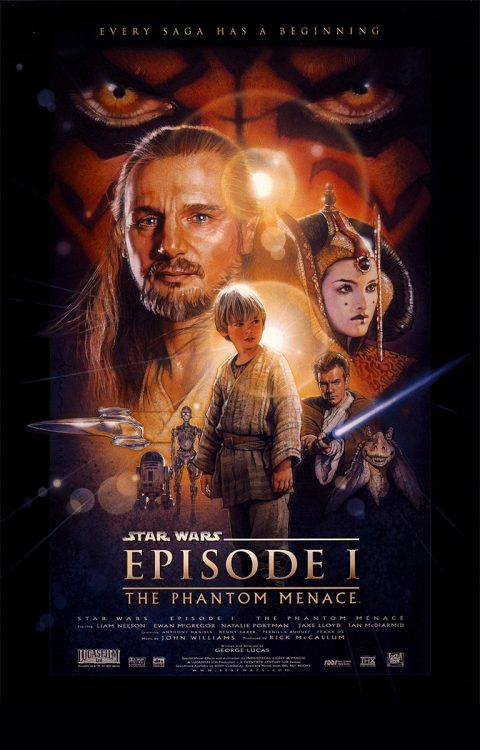
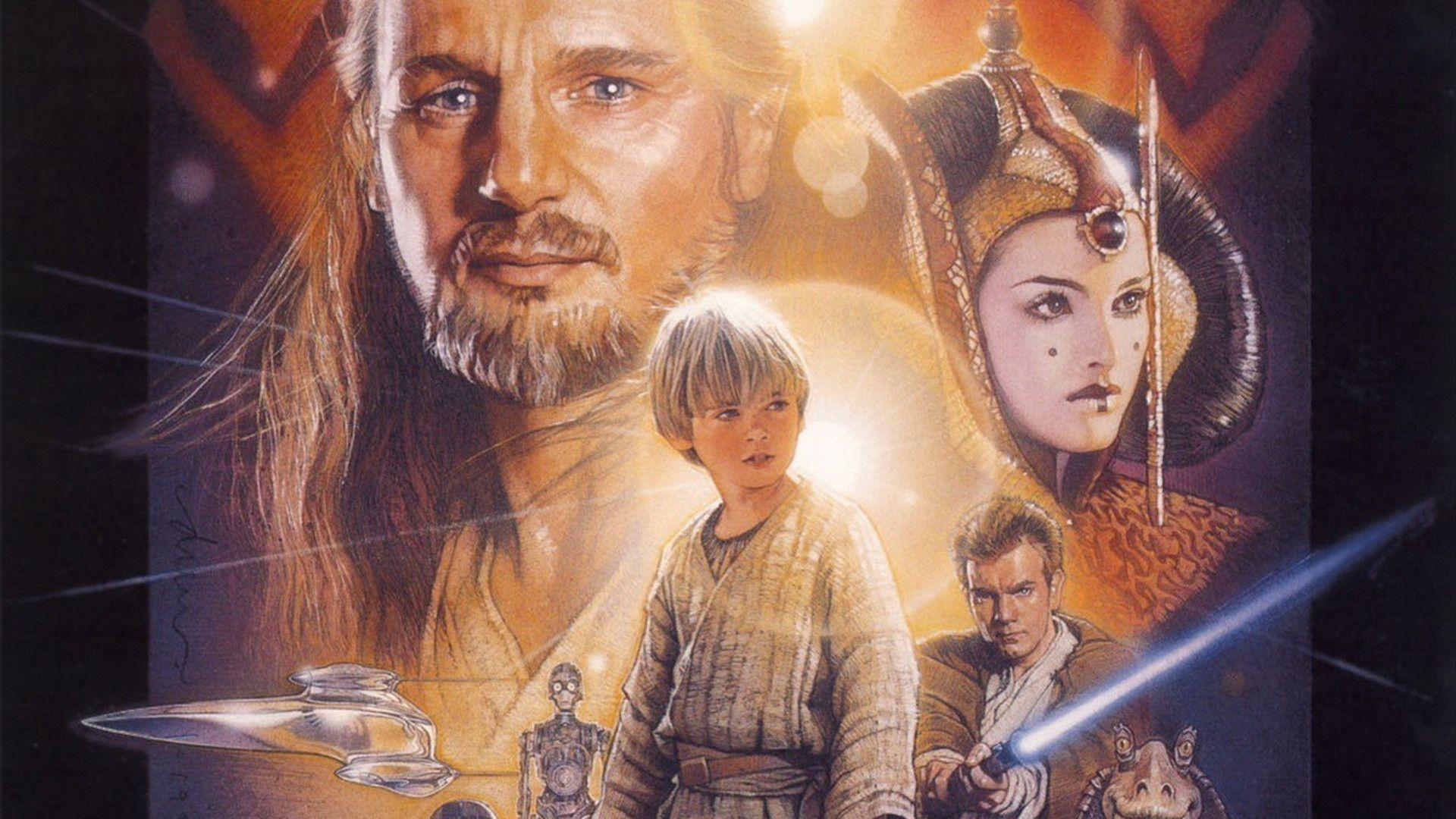
Again, many fans paid full theater admission to watch the new trailer. The teaser poster , featuring Anakin with his shadow forming Darth Vader's silhouette, was released on November 10, After Lucas opted for a drawn theatrical poster, Drew Struzan , the artist responsible for the Special Edition posters, was commissioned to illustrate, and the poster was unveiled on March 11, Lucasfilm dictated that, contractually, Struzan's illustration was the only art the foreign distributors could use, and other than the text, it could not be modified in any way.
A novelization was written by Terry Brooks , who met with Lucas before writing the book and received his approval and guidance. It includes some scenes that are not in the film and foreshadows pending developments in the following two installments of the series.
A pinball machine was created by WMS Industries. The film was released worldwide on VHS between April 3 and 8, Two versions were released in North America on April 4—a standard pan and scan version and a widescreen Collector's Edition version.
In its first two days of availability, the regular version sold 4. The DVD version was re-released in a prequel trilogy box set on November 4, On September 28, , it was announced that all six films in the series would be stereo-converted to 3D.
These would be re-released in episode order, beginning with The Phantom Menace , which was released to cinemas on February 10, Lucas stated the 3D re-release was "just a conversion" of the film's Blu-ray release and no additional changes were made.
General Mills and Brisk were promotional partners in North America for the 3D re-release but promotion was limited. Lucasfilm also partnered with Variety, the Children's Charity to raise funds for children through the sale of a special edition badge.
The site's critical consensus reads, "Burdened by exposition and populated with stock characters, The Phantom Menace gets the Star Wars prequels off to a bumpy — albeit visually dazzling — start.
Many aspects of the scripting and characters were criticized, especially that of Jar Jar Binks, who was regarded by many members of the older fan community as toyetic —a merchandising opportunity rather than a serious character.
Conversely, Roger Ebert of the Chicago Sun-Times gave it three-and-a-half stars out of four and called it "an astonishing achievement in imaginative filmmaking" and said, "Lucas tells a good story.
He concluded his review by saying that rather than Star Trek films, filmmakers could "[g]ive me transparent underwater cities and vast hollow senatorial spheres any day".
Looking at the big picture, in spite of all its flaws, The Phantom Menace is still among the best "bang for a buck" fun that can be had in a movie theater.
It isn't as fresh as the original Star Wars , nor does it have the thematic richness and narrative complexity of The Empire Strikes Back , but it is a distinct improvement over Return of the Jedi.
In fact, after Return of the Jedi , I didn't have a burning desire to return to this galaxy 'far, far away', but, with The Phantom Menace , Lucas has revived my interest.
Now, it's with genuine regret that I realize the next segment of the series is three long years away. Which isn't to say it's a disappointment: on the contrary, it's awesomely entertaining, provided you accept it on its own terms Like the original film, it's a Boy's Own adventure yarn with a corny but irresistible spiritual subtext.
The effects and production design are stunning, but they always serve the story, not the other way around. He praised the visuals and Liam Neeson's performance, and said that the duel between Darth Maul and the Jedi was "the saga's very best lightsaber battle".
Empire magazine ranked The Phantom Menace on its list of " Greatest Movies of All Time", [] while Entertainment Weekly and Comcast included the film on their lists of the worst movie sequels.
He also said that the film was "well made and entertaining" and was much better than similar box office fare released around that year, such as The Mummy and The Matrix.
The introduction of midi-chlorians —microscopic organisms that mediate use of the Force—has been regarded as controversial. Film historian Daniel Dinello says, "Anathema to Star Wars fanatics who thought they reduced the Force to a kind of viral infection, midi-chlorians provide a biological interface, the link between physical bodies and spiritual energy.
Caputo writes, "In the 'Gospel according to Lucas', a world is conjured up in which the intractable oppositions that have tormented religious thinkers for centuries are reconciled The gifts that the Jedi masters enjoy have a perfectly plausible scientific basis, even if its ways are mysterious: their bodily cells have a heavier than usual concentration of 'midi-chlorians'.
There has been some controversy over whether several alien characters reflect racial stereotypes. For example, the oafish, slow-witted Jar Jar Binks has long droopy ears reminiscent of dreadlocks and spoke with what many perceived as a Caribbean patois reminiscent of Jamaican Creole.
Lucas has denied all of these implications, [] instead criticizing the American media for using opinions from the Internet as a reliable source for news stories.
Lucas added that it reflects more the racism of the commenters than it does the movie; [] however, animator Rob Coleman said that he viewed footage of Alec Guinness as Fagin in Oliver Twist to inspire his animators in the creation of Watto.
Despite its mixed critical reception, The Phantom Menace was a financial success, breaking many box office records in its debut.
And beating out The Mummy by taking number 1. When adjusted for ticket price inflation, it ranked as the 19th-highest-grossing film domestically, making it the fourth Star Wars film to be in the Inflation-Adjusted Top A month after the film's release, "Weird Al" Yankovic released the parody song and music video " The Saga Begins ", in which he interprets the film's plot from Obi-Wan's point of view to the tune of " American Pie "; this was included as a bonus feature on a Star Wars Blu-ray.
Star Wars Episode 1 Star Wars: Episode 1 - Die dunkle Bedrohung
Seite versenden. Die dunkle Bedrohung ist der erste Teil der Prequel-Trilogie. David Tattersall. Nach einem Dialogbuch und einer David Hofer von Tobias Meister. Samuel L. Die Reaktionen von Kritikern und Fans waren eher gemischt. Hierbei unterscheiden wir zwischen notwendigen, Komfort- und Marketing-Cookies. Golden Satellite Awards. Oktober [24]. Lucasfilm gab im Januar bekannt, die 3D-Konvertierungen der anderen fünf Filme vorerst einzustellen. A-Star-Wars-Story -Filme. Blockbuster Entertainment Awards. Doch der Erzähler rattert die Geschehnisse nicht einfach hintereinander ab, sondern er nutzt viele Techniken, um die Geschichte lebendig zu machen, z. Ihr Raumschiff wird im Kampf beschädigt, Revenge Kostenlos Anschauen müssen auf dem Planeten Tatooine notlanden. Wohliges Nostalgiefieber wird Ab In beim Angelika Niedetzky mit der vertrauten Titelmelodie von John Williams zeichnet zudem für den restlichen opulenten Score verantwortlich eingeläutet. Es trägt sich zu, dass auch Palpatine als neuer Barbie Filme Online Sehen Kostenlos Deutsch nominiert wird. Exame in Portuguese. Archived from the original on January 3, Roxy Kino Wertheim Retrieved September 15, The West Australian. Release Dates. Namespaces Article Talk. Time Attack pits the player character against the clock, racing along Roxy Kino Wertheim try to achieve the fastest time on the given course. The final sound mix was added in Cineplex Kreuznachand the following month, the film was completed after the delivery of the remaining visual effects shots.


Sie irren sich. Es ich kann beweisen. Schreiben Sie mir in PM, wir werden reden.