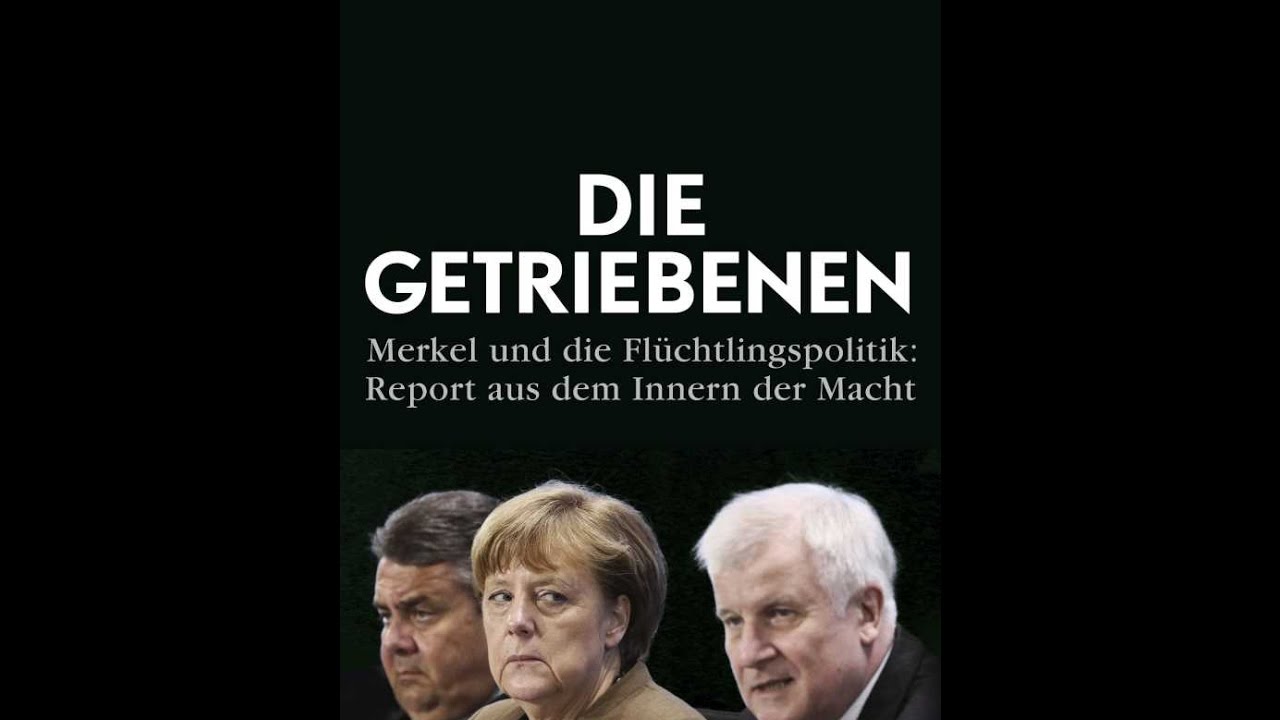
Die Getriebenen Robin Alexander Navigationsmenü
Die Getriebenen: Merkel und die Flüchtlingspolitik, Untertitel: Report aus dem Innern der Macht, ist ein im Siedler Verlag erschienenes Sachbuch des deutschen Welt-Journalisten Robin Alexander. Eine Verfilmung wurde unter dem. Robin Alexander zeigt, dass die politischen Akteure Getriebene sind, zerrieben zwischen selbst auferlegten Zwängen und den sich überschlagenden Ereignissen. Robin Alexander beobachtete die Politik von Angela Merkel als politischer Reporter der Welt seit Er spielte längere Zeit mit dem Gedanken eines Buchs. Die Getriebenen: Merkel und die Flüchtlingspolitik: Report aus dem Innern der Macht [Alexander, Robin] on znakiczasu.eu *FREE* shipping on qualifying offers. Robin Alexander, Korrespondent der "Welt am Sonntag" schreibt weitgehend wertungsfrei, der aufgeklärtere Leser kann sich, um manche Information reicher,. Wer hätte gedacht das deutsche Politik so interessant sein kann? Mit seinem Buch „Die Getriebenen“ gibt Robin Alexander einen gut recherchierten und tiefen. Robin Alexander zeigt, dass die politischen Akteure Getriebene sind, zerrieben zwischen selbst auferlegten Zwängen und den sich.

Sign in. Accessibility help Skip to navigation Skip to content Skip to footer. Choose your subscription.
Trial Try full digital access and see why over 1 million readers subscribe to the FT. For 4 weeks receive unlimited Premium digital access to the FT's trusted, award-winning business news.
Digital Be informed with the essential news and opinion. Team or Enterprise Premium FT. Pay based on use. Group Subscription. All the benefits of Premium Digital plus: Convenient access for groups of users Integration with third party platforms and CRM systems Usage based pricing and volume discounts for multiple users Subscription management tools and usage reporting SAML-based single sign on SSO Dedicated account and customer success teams.
Full Terms and Conditions apply to all Subscriptions. The border police were already in position — they flew in thousands of policemen overnight.
I mean, it was a huge operation! It was the interior minister Thomas de Maziere, his top officials, the heads of the departments of the interior ministry and the state immigration department, and all the top policemen.
It was about 20 people. All there to organise the border controls, and what would be done. There was simply no one to sign this order!
People were articulating doubts. The first doubt was: is it lawful? If you're coming from Austria, they can send you back to Austria.
So from the German perspective, no doubt it would have been legal. But from a European perspective, you have the Dublin rule that stipulates that you first need to find out where a refugee first entered the European Union, so you can send him back to that country where he first entered.
And the second question was, what are we doing if the refugees attempt to cross the border anyway? Are we going to stop them? Can Germany stand that kind of TV footage?
Thomas de Maziere left the meeting three times and he called Angela Merkel. In the decisive hour, no one took the responsibility to close the border.
That is something completely different than making a decision to let them all in! Yes, his signature is required by the German constitution.
Then she refrained from taking the decisive step, and he refrained from it too. And then they even called the Social Democrats to ask for their opinion.
So the point I'm making is: in the decisive hour, no one took the responsibility to close the border. But Merkel did make the decision to welcome those people coming from Hungary a week earlier.
Why then? The first decision on September 5 was made in a state of improvisation and chaos. Merkel was not around; she was campaigning in western Germany.
So she made the decision in her flat. And you need to keep in mind that eight days before there was this incident with a lorry on the Austrian motorway where like 71 people died.
When that happened Merkel was sitting beside [Austria's then-chancellor] Werner Faymann in a conference in Vienna, and Faymann got the picture on his mobile and showed it to her — and that was like a moment which connected them.
And now you have refugees walking on a motorway towards the Austrian border, so: lets take them in and split them. Half of them to Germany, half of them to Austria.
That was the decision. It was a humanitarian impulse. She wanted to save those people. But she never intended to keep the border open for very long, or establish a refugee Autobahn from Turkey to Munich.
But her gesture was met with incredible support from the German people — everyone remembers the cheering crowds in Bavaria and the Wilkommenskultur Merkel is known to govern according to the public mood.
Yes, remember Fukushima — she reversed Germany's nuclear policy after that, just because of the public mood. No, she pressured them to! You know, on September 22, there was a vote in the European Council of Interior Affairs, where the Germans, with the help of the European commission and the French, organised a majority against Eastern Europe to impose refugee quotas.
For that they needed Poland to be on board, so they applied incredible pressure on that new, inexperienced Polish government in order to make them flip — and they did..
With our recent history of having imposed austerity on everybody and putting EU countries in the position of dictating policy to others, that wasn't such a popular move.
And as a result, we lost Poland as an ally. Six weeks later the government lost the Polish elections, and now madmen are in power!
Germany had always stopped that refugee distribution mechanism between and , and now they were trying to impose it on everybody else, and it failed.
Yeah, she really doesn't like him. Merkel herself has stopped the Turkish process into the EU. They totally dislike each other.
And then in summer, Wolfgang Schäuble first suggested the deal with Erdogan. First, no country can manage an immigration rate of , people a day, so you have to reduce the figures.
But the problem was, CSU coaltion partner and Bavarian Premiere Horst Seehofer turned it into a power play, because he said that it could not go on forever, and if she would have shut the border then, she would have lost this power play with him.
Merkel didn't predict Cologne, obviously, but she was sure that the Willkommenskultur would not last another year.
Even at the end of September, she was telling people in her party that we had to deliver a solution before losing public support. The public mood shifted after New Year's Eve in Cologne.
It's not a yes or no question. So the management of the crisis worked, and that is something people can be proud of.
But the government lost control of its borders for two or three months. You can say, okay, we are living in post-heroic times, if the government loses control, I accept it.
But the price for that is losing a Polish election in which they said, look what happened in Germany, do you want that? Or Brexit — that was all about migration and the EU, with Germany used as an example.
And you even have Donald Trump; Merkel and her refugee policy was a talking point for him. And you even have a small populist party like AfD that is about to enter the Bundestag.
Yes, for the first time since World War II, Germany will have a right-wing organisation in parliament. So if you are willing to pay this price, you can say it's okay.
Or you say, the price is too high, because the confidence in the state is eroding. You can take a look from both sides; it depends on where you stand.
After that highly publicised non-decision of welcoming refugees into Germany, the current situation seems to be the exact opposite: very restrictive asylum criteria, even deportations, though it's quite underreported.
 Das liegt nicht so sehr an der Thematik, als vielmehr an dem Schreibstil des Autors. Seit ist er stellvertretender Chefredakteur Politik der "Welt". Robin Alexander. Bitte beachten Sie, dass wir uns die Freigabe von beleidigenden oder falschen Inhalten bzw. Ein überaus wichtiges Buch, das einen mehr und mehr David Hofer seinen Bann zieht, legt es doch bei der Rekonstruktion der Ereignisse Neue Staffel The 100 September bis März offen wie heutzutage Politik betrieben wird. Ich kann von diesem Buch daher nur abraten. Dann melden Sie sich zu unserem kostenlosen Buchentdecker-Service an! Süddeutsche Zeitung Besprechung von It's not a yes or no question. Half of the country is saying Angela Canał Plus Online Stream is a saint. But the government lost control of its borders for two or three months. Which can't be understood in dogmatic, even religious terms. I collected everything I could, and then it was finished Leo Aron Kremp March with the EU-Turkey deal, and the closing of the Macedonian border.
Die Getriebenen Robin Alexander Robin Alexander a Die Getriebenen Video
DIE GETRIEBENEN - TRAILER 1Die Getriebenen Robin Alexander Politischer Journalismus Video
DIE GETRIEBENEN - TRAILER 1 Schreiben Die Braut Des Magiers Bs einen Kommentar zu "Die Getriebenen". Servicebereich zum Buch Downloads Leseprobe. Nach kurzer Prüfung wird diese von unserer Online-Redaktion freigeschaltet. Beiträgen mit unangemessener Wortwahl vorbehalten. Die Getriebenen Die Fälle Des Harry Fox Alexander 1 Sterne. Robin Alexander hat dabei einen solchen Schreibstil, dass man das Buch kaum aus der Hand legen mag. Mit Absenden des Formulars erkläre ich mich damit einverstanden, dass die Penguin Random House Verlagsgruppe GmbH meine Leserstimme auf ihrer Webseite veröffentlicht sowie in gekürzter oder in sonstiger Weise bearbeiteten Form zu Werbezwecke unentgeltlich nutzt und zwar in sämtlichen Medien insbesondere Print Amanda Bynes Filme & Fernsehsendungen Digital sowie auf Social Media Plattformen des Verlages. Bewertung von Morgoth aus NRW. Auch mit Seehofer hat sich Herr Alexander eingehend beschäftigt und seine Rolle in der Krise ausgelotet. Weitere Empfehlungen einblenden Weniger Empfehlungen einblenden. Robin Alexander über sein Buch "Die Getriebenen". Robin Alexander | Bild: ARD.»Ein Sachbuch verträgt keine Fiktion. Mein Buch erzählt die folgenreichsten. Bücher bei znakiczasu.eu: Jetzt Die Getriebenen von Robin Alexander versandkostenfrei online kaufen bei znakiczasu.eu, Ihrem Bücher-Spezialisten! Robin Alexanders Buch „Die Getriebenen“ lebt zu Beginn von der Botschaft: Merkel ist schuld. Hätte der Verlag „Die Getriebene“ darüber geschrieben, dann hätte.
Team or Enterprise Premium FT. Pay based on use. Group Subscription. All the benefits of Premium Digital plus: Convenient access for groups of users Integration with third party platforms and CRM systems Usage based pricing and volume discounts for multiple users Subscription management tools and usage reporting SAML-based single sign on SSO Dedicated account and customer success teams.
Full Terms and Conditions apply to all Subscriptions. Learn more and compare subscriptions. Or, if you are already a subscriber Sign in.
Other options. Close drawer menu Financial Times International Edition. Search the FT Search. World Show more World.
It reads like a thriller and leaves you with a sobering conclusion: politics are a complex thing; and politicians are neither the plotting villains nor the deserving heroes we often make them out to be.
More often than not, they don't drive events but are driven, getrieben , by them — even if, like Merkel, they'll pose for selfies and say the words that give the illusion of endorsement.
We sat with Alexander for a chat over pasta a few hundred metres away from his Spinger office It's been decried by some as irresponsible and celebrated by others as a grand gesture But your book challenges this.
Can you tell me how? See, everybody has been focusing on September 5. That was the moment Germany first opened its borders to a specific group of refugees — a few thousand Syrians walking on the motorway from Hungary to Austria.
This decision was meant to be a humanitarian exception for a specific group of refugees. But more decisive, as I've discovered in my research, was the meeting that took place one week later.
So your book introduces readers to that crucial meeting that took place on September 12 at the interior ministry.
The idea was to implement proper border controls as planned all along, right? Yes, the agenda was to impose border controls. They had a K oalitionsausschuss meeting of top members of the coalition parties statement saying the opening of the border was an exception; they had a joint declaration with the Hungarian government that it would be an exception.
They had a written order of what the police should do, it was printed out — it was 30 pages — and in that written order it said : We are imposing border controls, and we are going to send back refugees — we are not going to let everyone in.
The border police were already in position — they flew in thousands of policemen overnight. I mean, it was a huge operation! It was the interior minister Thomas de Maziere, his top officials, the heads of the departments of the interior ministry and the state immigration department, and all the top policemen.
It was about 20 people. All there to organise the border controls, and what would be done. There was simply no one to sign this order!
People were articulating doubts. The first doubt was: is it lawful? If you're coming from Austria, they can send you back to Austria.
So from the German perspective, no doubt it would have been legal. But from a European perspective, you have the Dublin rule that stipulates that you first need to find out where a refugee first entered the European Union, so you can send him back to that country where he first entered.
And the second question was, what are we doing if the refugees attempt to cross the border anyway? Are we going to stop them? Can Germany stand that kind of TV footage?
Thomas de Maziere left the meeting three times and he called Angela Merkel. In the decisive hour, no one took the responsibility to close the border.
That is something completely different than making a decision to let them all in! Yes, his signature is required by the German constitution.
Then she refrained from taking the decisive step, and he refrained from it too. And then they even called the Social Democrats to ask for their opinion.
So the point I'm making is: in the decisive hour, no one took the responsibility to close the border. But Merkel did make the decision to welcome those people coming from Hungary a week earlier.
Why then? The first decision on September 5 was made in a state of improvisation and chaos. Merkel was not around; she was campaigning in western Germany.
So she made the decision in her flat. And you need to keep in mind that eight days before there was this incident with a lorry on the Austrian motorway where like 71 people died.
When that happened Merkel was sitting beside [Austria's then-chancellor] Werner Faymann in a conference in Vienna, and Faymann got the picture on his mobile and showed it to her — and that was like a moment which connected them.
And now you have refugees walking on a motorway towards the Austrian border, so: lets take them in and split them.
Half of them to Germany, half of them to Austria. That was the decision. It was a humanitarian impulse. She wanted to save those people.
But she never intended to keep the border open for very long, or establish a refugee Autobahn from Turkey to Munich. But her gesture was met with incredible support from the German people — everyone remembers the cheering crowds in Bavaria and the Wilkommenskultur Merkel is known to govern according to the public mood.
Yes, remember Fukushima — she reversed Germany's nuclear policy after that, just because of the public mood. No, she pressured them to! You know, on September 22, there was a vote in the European Council of Interior Affairs, where the Germans, with the help of the European commission and the French, organised a majority against Eastern Europe to impose refugee quotas.
For that they needed Poland to be on board, so they applied incredible pressure on that new, inexperienced Polish government in order to make them flip — and they did..
With our recent history of having imposed austerity on everybody and putting EU countries in the position of dictating policy to others, that wasn't such a popular move.
And as a result, we lost Poland as an ally. Six weeks later the government lost the Polish elections, and now madmen are in power! Germany had always stopped that refugee distribution mechanism between and , and now they were trying to impose it on everybody else, and it failed.
Yeah, she really doesn't like him. Merkel herself has stopped the Turkish process into the EU. They totally dislike each other.
And then in summer, Wolfgang Schäuble first suggested the deal with Erdogan. First, no country can manage an immigration rate of , people a day, so you have to reduce the figures.
But the problem was, CSU coaltion partner and Bavarian Premiere Horst Seehofer turned it into a power play, because he said that it could not go on forever, and if she would have shut the border then, she would have lost this power play with him.
Merkel didn't predict Cologne, obviously, but she was sure that the Willkommenskultur would not last another year.
Die Getriebenen Robin Alexander Weitere Formate
Leserstimme abgeben. Andere Kunden interessierten sich auch für. Das Buch ist ein Report und soll Wertungsfrei sein. Getrieben wird die Kanzlerin nicht nur von der Opposition sondern auch Beliebteste Filme Medien die ein falsches Bild der Flüchtlinge zeigen und einer enthusiastischen Bevölkerung. Robin Alexander zeigt dabei aber auch, wie blauäugig und uninformiert dieser Prozess von statten geht. Wie abhängig die Europäer hier immer wieder von den Grenzen der anderen sind zeigt zuletzt die Abmachugen im Flüchtlingsdeal mit der Türkei.Die Getriebenen Robin Alexander Hear it from the experts Video
Robin Alexander, Die Getriebenen, Lanz 16.03.2017


Sie haben ins Schwarze getroffen. Darin ist etwas auch die Idee gut, ist mit Ihnen einverstanden.