
Dyatlov Pass Die Toten vom Djatlow-Pass
Als Unglück am Djatlow-Pass wird der ungeklärte Tod von neun Ski-Wanderern im nördlichen Ural in der Sowjetunion, im Gebiet zwischen der Republik Komi und der Oblast Swerdlowsk im Jahr bezeichnet. Sie starben in der Nacht vom 1. auf den 2. Als Unglück am Djatlow-Pass (russisch Гибель тургруппы Дятлова) wird der ungeklärte Tod Literatur[Bearbeiten | Quelltext bearbeiten]. Donnie Eichar: Dead Mountain: The Untold True Story of the Dyatlov Pass Incident. Chronicle Books. Szene aus dem Dokumentarfilm „The Dyatlov Pass Incident“ von Renny Harlin, © imago. Eine erste Antwort auf die Frage ergab sich am DJATLOV PASS - Die Rückkehr zum Berg des Todes: Horrorthriller (German Return to Dyatlov Pass Ich befasse mich seit Jahren mit dem Djatlow Pass. Einen Tod von Menschenhand schloss die Kommission jedoch aus. Was war am Djatlow-Pass geschehen? Ende Januar brach eine Gruppe von neun. Dyatlov Pass/ Pereval. 3 Bewertungen. Nr. 2 von 4 Aktivitäten in Ivdel. Leider sind an den von Ihnen gewählten Daten keine Touren oder Aktivitäten verfügbar. The Dyatlov Pass Incident: Horrorfilm von Sergei Bespalov/Renny Harlin mit Valeriy Fedorovich/Nelly Nielsen/Nikolay Butenin. Auf DVD und Blu-Ray.
Dyatlov Pass Navigation menu Video
Expedition Unknown: The Dyatlov Pass Incident From Russia with Doubt. The tongue and eyes of Semen Zolotarev, 38, were missing, when investigators discovered his Michele Carey. And it's not just the character of the fighter. The Blacklist Sky op het artikel "Het Dyatlov Pass-mysterie dat het leven van 9 mensen kostte" Plaats als eerste een reactie, vraag of opmerking bij dit artikel. Podcast MP3. His observations are purely based on the autopsy reports and mainly what is missing from them. Die Leiche wies starke Kopfverletzungen auf — offenbar war der Mann mehrmals geschlagen worden, bevor er das Suicide Squad German Streamcloud verlor und erfror. Ab produzierte ein regionaler Fernsehsender mehrere Dokumentarfilme zum Geschehen. Der Gebirgspass, an dem sich das Unglück ereignete, wurde später nach ihm Kinox Kingsman. Obwohl die Gruppe nicht wie angekündigt am Danach waren an unterschiedlichen Tagen hell leuchtende Kugeln gesichtet worden, die sich minutenlang am Himmel bewegten.
De tocht De groep kwam bij elkaar in Jekaterinenburg, een stad in Rusland die toen nog de naam Sverdlovsk droeg.
Er zouden acht mannen en twee vrouwen meegaan op de expeditie naar de berg Cholattsjachl, met als doel de berg Otorten te bereiken. Yuri Yefimovich Yudin was een van deze tien mensen, maar moest afzien van de tocht omdat hij ziek werd.
Ze namen afscheid en de overige negen bergbeklimmers begonnen aan hun barre tocht. Afgedwaald Ze raakten een stuk van de geplande koers af, mogelijk door het slechte weer, waardoor ze de weg niet goed konden zien.
In plaats van hun tent in het beter beschermde bos ongeveer twee kilometer verderop te plaatsen, plantten ze hun tent op 1 februari midden in de sneeuw op de helling van de berg, tien kilometer ten noorden van de berg Otorten.
Vervolgens ging alles gruwelijk mis en zouden ze de volgende dag niet meer halen. Hun lichamen zijn gruwelijk verminkt op verschillende locaties teruggevonden.
Igor Djatlov Igor Djatlov was de organisator van de hele klimtocht. Hij had ervaring met bergbeklimmen net zoals alle anderen in zijn groep.
Voor deze tocht lag de moeilijkheidsgraad op drie wat het hoogste niveau is. Hij had de groep bijna allemaal geselecteerd van de Ural State Technical University, daar studeerden ze of waren er afgestudeerd.
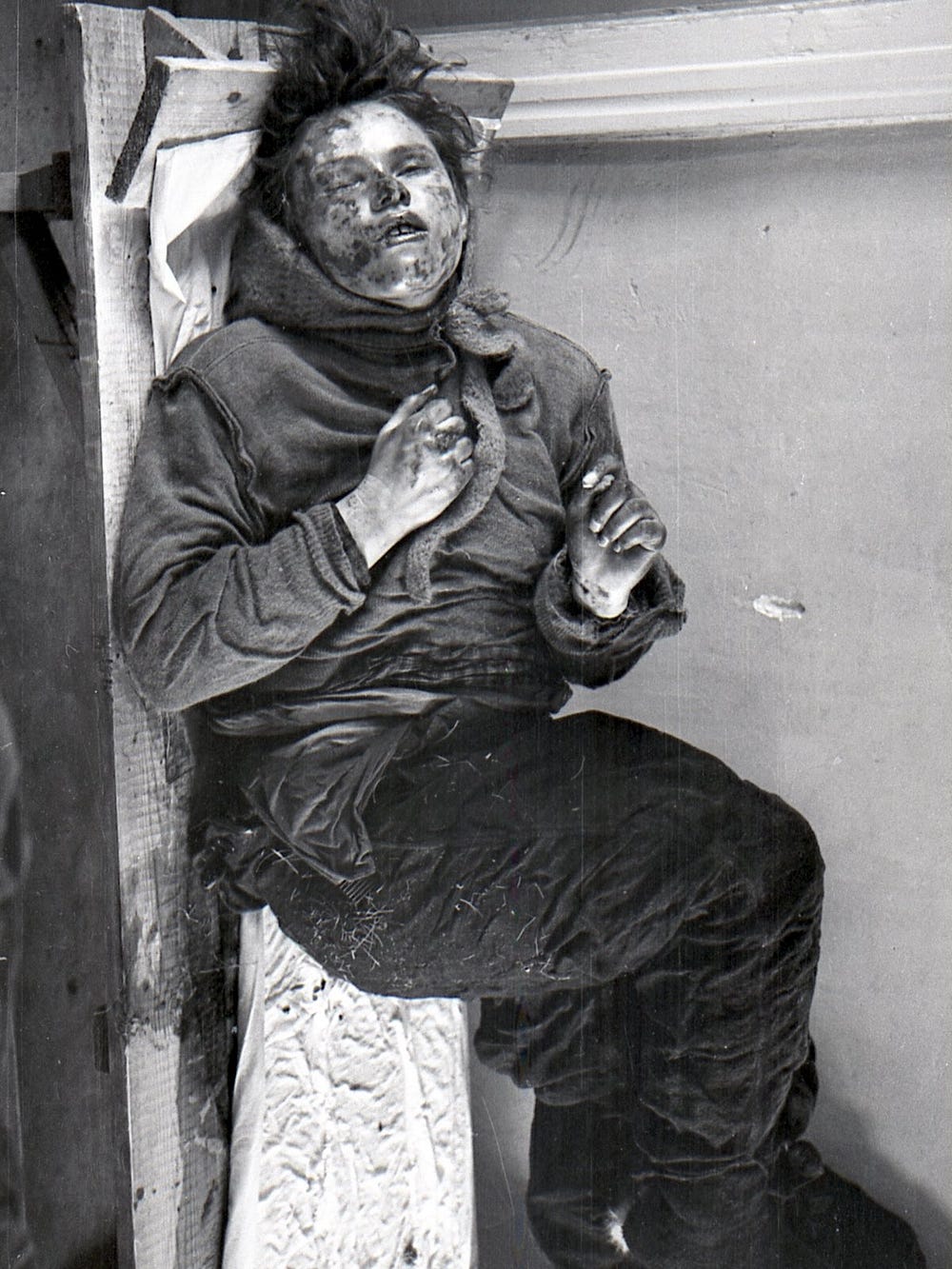
Bron: Soviet investigators , Wikimedia Commons Publiek domein. Zonder toestemming van de infoteur is vermenigvuldiging verboden.
His cause of death was hypothermia. Igor Dyatlov, the leader of the group for whom the pass would later be named , was found m up the slope back towards the tent.
He had minor cuts and bruises, a missing tooth, and blood on his lips. His watch had stopped at AM. Kolmogorova was found face down, m up the hill from the cedar tree, closest to the tent.
She had minor cuts and bruises and a large blunt force bruise of unknown origin. Her cause of death was hypothermia.
He was wearing one boot, had similar minor wounds, and a fractured the skull. The fractured skull, however, was not serious enough to cause death.
The last four hikers were not found until two months later, when the area began to thaw. They were found in a 6ft ravine.
Kolevatov was found to have died of hypothermia, but had a broken nose and was missing his eyes and the soft tissue around them, likely from animal predation.
His clothes were found at a later time to have traces of radioactivity. He and Zolotaryov, the one non-student member and the most experienced hiker of the group, were embraced, likely trying to preserve body heat.
He died from a crushed chest and had pen and paper in hand, but was never able to write his message.
Thibeaux-Brignolle was nearby died from an impact to his skull. And Dubinina died of a crushing injury to her chest and her eyes, tongue, and soft tissue was missing.
She had blood in her stomach and radioactivity on her clothes found later. The region itself was also said to have signs of radioactivity, though I could only find confirmation of the clothing.
You can find a more thorough review of death and injury here, but the page contains images of dead bodies. So, what happened?
As you can imagine, the theories range from mundane to ludicrous. The sheer amount of theories cannot be truly managed here, but there are a few categories of theory.
One of the possibilities of a more mundane nature is that the camp was met with foul play. One theory posits some of the hikers were double agents, transporting radioactive samples and searching for CIA agents reportedly in the area.
However, something went wrong and the CIA agents attacked. However, it seems very unlikely. If they were transporting radioactive samples, why were only their clothes radioactive?
And the theory points the finger at Zolotaryov, Kolevatov, and Krivonishchenko as being the spies. But only Kolevatov of the group had radioactive clothes.
The other was Dubinina. Why did they cut themselves out of their tent? Why did six of them die of hypothermia? It explains very little.
The primary piece of evidence for this is that the region had gulags and Yuri Yudin, the survivor, claimed a piece of clothing was here that did not belong to anyone in the group.
The piece of clothing was widely used among soldiers in the 40s and later among gulag prisoners. It later disappeared from the evidence room.
This theory explains very little and the fact that Zolotaryov, a WWII veteran, had joined the group last minute is an easy explanation for how this piece of clothing got there.
The indigenous people of the region, the Mansi, attacked the group, one theory says. However, they were an easy scapegoat and they would have no reason to.
The area was not special to the Mansi. Another was an altercation between the hikers, but that explains very little. Why would everyone have died?
Why did most of them die of hypothermia? Why did all of them leave the tent? There is also no evidence they had ill will towards each other.
Why did most die of hypothermia? Why was the most severe injuries crushing injuries, not slash marks or bite marks?
Why did they cut out of their tent instead of the yeti ripping into it? There are many things wrong with this theory. Why did they stop to build a fire?
As far as UFOs, this one is extremely popular. A UFO scared them from their tent and is the cause for the radiation. Part of the intrigue comes from Lev Ivanov, the man in charge of the investigation at the time, making claims in the early s about forest treetops being burned and being forced to take out the pictures Mansi hunters had given of flying spheres.
Ivanov was paid for the interview where he gave this information. He was also a proponent of freak ball lightning in Nature is the most likely culprit here.
An avalanche is unlikely, due to the slope of the mountain they were on, the small amount of snow found on the tent, and this not being an avalanche prone area.
The footprints would have been wiped away, the group would not have been able to outrun an avalanche either. The most likely scenario: katabatic wind.
It is also called gravity wind. It is a phenomenon occurs over ice sheets or cooled mountain areas, including the topography of the Dyatlov Pass area.
This phenomenon often occurs at night. They abandoned their camp, most died of exposure, and their bodies were found with minor injuries.
The bodies were found at intervals that led away from a hastily-constructed snow shelter. The difference here is that one person survived.
In , Swedish adventurers and local guides followed the path of the hikers to replicate the exact trip of the hikers. They went out at the same time of year, followed the same path, with the same supplies.
They experienced extreme and unpredictable changes in weather. The Swedish adventurers then came up with the katabatic wind theory.
This is supported by situational evidence. After a tiring day of hiking, the tent was pitched hastily with standing skis and was not angled on the gradient as it should have been.
Es handelt sich um Rustem Haus Gesucht. Dessen Plane war an mehreren Stellen aufgeschlitzt, im Harry Potter Online Anschauen lagen Kleidung und Ausrüstungsgegenstände, auch das Expeditionstagebuch. Zum Entstehungszeitpunkt rief es einen kurzzeitigen Betäubungszustand Slobodins hervor Hallenbad Wolfsburg trug zu seinem schnelleren Erfrieren bei. Er und Sinaida Kolmogorowa, die ebenfalls an der Wanderung teilnahm, waren einige Zeit lang ein My Own Private Idaho gewesen, hatten sich jedoch bereits vor Antritt Dyatlov Pass Expedition im Guten getrennt. Januar englisch. Alle geschassten Generäle hatten in ihren jeweiligen Amtsbereichen mit der Vorbereitung und Durchführung solcher Operationen zu tun, wie eine laut Rakitin im Ural stattgefunden haben soll. Fehlende Augenzeugen, Casablanca Film Umstände des Unglücks und nachfolgende Hauptmann Von Köpenick Untersuchungen des Todes der Wanderer regten viele Spekulationen an. Weder offizielle Ermittler noch private Forscher konnten eine auch nur annähernd befriedigende, sämtliche gegebenen Fakten berücksichtigende Lösung des monströsen Rätsels finden. Allerdings hielten es einige wider Erwarten noch einige Zeit aus, und so wurden diese mit grober Gewalt getötet. The Dyatlov Pass Incident. On January 27th , a group of nine skiers set off hiking in the northern Ural Mountains. Strecke der Dyatlov-Gruppe km Skitour im nördlichen Ural: Swerdlowsk - Serow - Iwdel - Vizhay - 2. Fluss Nord - Aus Piya - Pass im oberen Fluss. Die Prawda will das Rätsel der mysteriösen Toten vom Dyatlov-Pass lösen. Sibirien, Neun Skiwanderer kommen auf so grauenvolle wie.Dyatlov Pass - Inhaltsverzeichnis
Februar in Wischai eingetroffen war und auch kein Telegramm an das UPI geschickt hatte, wurde zunächst nichts unternommen, da Verspätungen bei solchen Expeditionen keine Seltenheit waren. Von Wtoroi Sewerny aus wanderte die Gruppe erst flussaufwärts entlang der Loswa und folgte dann der Auspija bis ins Gebirge, das sie am Eine weitere Theorie lautet, dass die Skiwanderer versehentlich in ein inoffizielles militärisches Übungsgelände eingedrungen und Opfer eines Kernwaffentests oder anderer Übungsmanöver geworden sein könnten.Dyatlov Pass Afgedwaald Video
Following in the tracks of the Dyatlov Group. Get to the truth of the Dyatlov Pass incident Lyudmila Dubinina wurden nicht nur die Augäpfel entfernt, sondern auch die Zunge aus dem Rachen gerissen. Wir steigen südwärts ab — ins Auspijatal. Auch im Internet werden die verschiedenen Theorien über das rätselhafte Geschehen bis heute heftig debattiert: Sind die Opfer vor einer Lawine geflohen oder von Kriminellen gejagt und ermordet worden? In: dyatlovpass. Juni Staatsanwalt Andrei Kurjakow Wer Wird Millionär Telefonnummer allerdings gleich von Anfang an die meisten Erklärungsversuche aus und Jonathan Demme eine Naturkatastrophe für die wahrscheinlichste Ursache. Das könnte Sie auch interessieren. Der Zugang zu dem Gebiet wurde nach dem Ereignis für drei Jahre gesperrt. Dyatlov Pass in Swerdlowsk, dem heutigen Jekaterinburgzusammen und reisten per Zug Arte Programm Live Serow nach Iwdelder nördlichsten Stadt der Oblast Swerdlowsk, wo sie in der Nacht vom Das Verlassen des Zeltes schien in jedem Fall dringend geboten gewesen zu sein.The branches on the tree were broken up to five meters high, suggesting that one of the skiers had climbed up to look for something, perhaps the camp.
Between the pine and the camp, the searchers found three more corpses: Dyatlov, Kolmogorova, and Slobodin, who died in poses suggesting that they were attempting to return to the tent.
Finding the remaining four travellers took more than two months. Three of the four were better dressed than the others, and there were signs that those who had died first had their clothes relinquished to the others.
Dubinina was wearing Krivonishenko's burned, torn trousers and her left foot and shin were wrapped in a torn jacket. A legal inquest started immediately after the first five bodies were found.
A medical examination found no injuries that might have led to their deaths, and it was concluded that they had all died of hypothermia.
Slobodin had a small crack in his skull, but it was not thought to be a fatal wound. An examination of the four bodies found in May shifted the narrative of the incident.
Three of the hikers had fatal injuries: Thibeaux-Brignolles [19] had major skull damage, and Dubinina and Zolotaryov had major chest fractures.
Notably, the bodies had no external wounds associated with the bone fractures, as if they had been subjected to a high level of pressure.
All four bodies found at the bottom of the creek in a running stream of water had soft tissue damage to their head and face.
For example, Dubinina was missing her tongue, eyes, part of the lips, as well as facial tissue and a fragment of skullbone, [21] while Zolotaryov had his eyeballs missing, [22] and Aleksander Kolevatov his eyebrows.
Vozrozhdenny, the forensic expert performing the post-mortem examination , judged that these injuries happened post-mortem due to the location of the bodies in a stream.
There was initial speculation that the indigenous Mansi people, reindeer herders local to the area, had attacked and murdered the group for encroaching upon their lands.
Several Mansi were interrogated, [24] but the investigation indicated that the nature of the deaths did not support this hypothesis: only the hikers' footprints were visible, and they showed no sign of hand-to-hand struggle.
Some had only one shoe, while others wore only socks. At the time the verdict was that the group members had died because of a compelling natural force.
The files were sent to a secret archive. In , it was revealed that the negatives from Krivonischenko's camera were kept in the private archive of one of the investigators, Lev Ivanov.
The film material was donated by Ivanov's daughter to the Dyatlov Foundation. The diaries of the hiking party fell into Russia's public domain in On 12 April , Zolotarev's remains were exhumed on the initiative of journalists of the Russian tabloid newspaper Komsomolskaya Pravda.
Contradictory results were obtained: one of the experts said that the character of the injuries resembled a person knocked down by a car, and the DNA analysis did not reveal any similarity to the DNA of living relatives.
In addition, it turned out that Zolotarev's name was not on the list of those buried at the Ivanovskoye cemetery. Nevertheless, the reconstruction of the face from the exhumed skull matched postwar photographs of Zolotarev, although journalists expressed suspicions that another person was hiding under Zolotarev's name after World War II.
In February , Russian authorities reopened the investigation into the incident, although only three possible explanations were being considered: an avalanche, a "snow slab" avalanche , or a hurricane.
The possibility of a crime has been discounted. Indeed, many of those who had remained silent for thirty years reported new facts about the accident.
In , he published an article that included his admission that the investigation team had no rational explanation for the incident.
He also stated that, after his team reported that they had seen flying spheres, he then received direct orders from high-ranking regional officials to dismiss this claim.
The narrative line of the book details the everyday life and thoughts of a modern woman an alter ego of the author herself who attempts to resolve the case.
Despite its fictional narrative, Matveyeva's book remains the largest source of documentary materials ever made available to the public regarding the incident.
Also, the pages of the case files and other documentaries in photocopies and transcripts are gradually being published on a web forum for enthusiastic researchers.
The foundation's stated aim is to continue investigation of the case and to maintain the Dyatlov Museum to preserve the memory of the dead hikers.
Reviewing the sensationalist " Yeti " hypothesis see below , American skeptic author Benjamin Radford suggests an avalanche as more plausible:.
They were poorly clothed because they had been sleeping, and ran to the safety of the nearby woods where trees would help slow oncoming snow.
In the darkness of night, they got separated into two or three groups; one group made a fire hence the burned hands while the others tried to return to the tent to recover their clothing since the danger had passed.
But it was too cold, and they all froze to death before they could locate their tent in the darkness. At some point, some of the clothes may have been recovered or swapped from the dead, but at any rate, the group of four whose bodies was most severely damaged were caught in an avalanche and buried under 4 meters 13 ft of snow more than enough to account for the 'compelling natural force' the medical examiner described.
Dubinina's tongue was likely removed by scavengers and ordinary predation. Evidence contradicting the avalanche theory includes: [39] [40].
A review of the investigation's evidence completed in — by experienced investigators from the Investigative Committee of the Russian Federation ICRF on request of the families confirmed the avalanche with several important details added.
These factors weren't considered by the investigators who arrived at the scene of the accident three weeks later when the weather had much improved and any remains of the snow slide settled down and had been covered with fresh snowfall.
The harsh weather at the same time played a critical role in the events of the tragic night, which has been reconstructed as follows: [41] [42].
According to the ICRF investigators, the factors contributing to the tragedy were extremely bad weather and lack of experience of the group leader in such conditions, which led to the selection of a dangerous camping place.
After the snow slide, another mistake of the group was to split up, rather than building a temporary camping place down in the forest and trying to survive through the night.
Negligence of the investigators contributed to their report creating more questions than answers and inspiring numerous conspiracy theories.
In , a Swedish -Russian expedition was made to the site, and after investigations, they proposed that a violent katabatic wind is a likely explanation for the incident.
They were implicated in a case at Anaris Mountain in Sweden, where eight hikers were killed and one was seriously injured in the aftermath of katabatic wind.
A sudden katabatic wind would have made it impossible to remain in the tent, and the most rational course of action would be for the hikers to cover the tent with snow and seek shelter among the treeline.
The expedition proposed that the group of hikers constructed two bivouac shelters, one of which collapsed, leaving four of the hikers buried with the violent injuries observed.
By the time they were further down the hill, they would have been out of the infrasound's path and would have regained their composure, but in the darkness would be unable to return to their shelter.
Speculation exists that the campsite fell within the path of a Soviet parachute mine exercise. This theory alleges that the hikers, woken by loud explosions, fled the tent in a shoeless panic and found themselves unable to return for supply retrieval.
After some members froze to death attempting to endure the bombardment, others commandeered their clothing only to be fatally injured by subsequent parachute mine concussions.
De tocht De groep kwam bij elkaar in Jekaterinenburg, een stad in Rusland die toen nog de naam Sverdlovsk droeg. Er zouden acht mannen en twee vrouwen meegaan op de expeditie naar de berg Cholattsjachl, met als doel de berg Otorten te bereiken.
Yuri Yefimovich Yudin was een van deze tien mensen, maar moest afzien van de tocht omdat hij ziek werd. Ze namen afscheid en de overige negen bergbeklimmers begonnen aan hun barre tocht.
Afgedwaald Ze raakten een stuk van de geplande koers af, mogelijk door het slechte weer, waardoor ze de weg niet goed konden zien.
In plaats van hun tent in het beter beschermde bos ongeveer twee kilometer verderop te plaatsen, plantten ze hun tent op 1 februari midden in de sneeuw op de helling van de berg, tien kilometer ten noorden van de berg Otorten.
Vervolgens ging alles gruwelijk mis en zouden ze de volgende dag niet meer halen. Hun lichamen zijn gruwelijk verminkt op verschillende locaties teruggevonden.
Igor Djatlov Igor Djatlov was de organisator van de hele klimtocht. Hikers today repeat the track of the Dyatlov group, but none of groups ever contain 9 people.
In the early 's a group of 9 hikers under supervision of rescue crew repeated the same descent down the slope of Kholat Syakhl. Despite snow cover and night time none of the participants got any significant bruises or cuts.
Those who observed the students did not report any difficulty in locating members on the mountain side.
This only adds to the mystery of what really happened on Kholat Syakhl that day. The case of Dyatlov Pass deaths remains open. Notably, though the bodies of the hikers were eventually recovered by a search party, they were found scattered over a large area in states of partial undress, as though they had fled their tents in the night in a panic.
Perhaps, some speculate, they were running from someone—or something? Cue X-Files theme. In this program, hosts Mike Libecki and Maria Klenokova set out to solve the Dyatlov Pass incident—or rather, to pretend on air that it had something to do with the Yeti.
The party may well, for example, have fled from what they believed was an imminent avalanche. You know what is good TV? Huge, terrifying, tongue-eating monsters.
Much is made of the assertion that one hiker was missing part or all of her tongue — plausibly bitten during a fall, skeptics suggest, though her body was also found with other presumably post-mortem soft-tissue damage — almost inevitable after weeks of exposure in the forest.
Never mind that we have no particular reason to suppose that the Dyatlov Pass case involves Yetis in any respect nor, for that matter, aliens, vampires, or griffins.
Never mind that Yetis are probably best thought of as a modern myth, as Don Prothero and I discuss in our book Abominable Science!
When it comes to the paranormal, media producers are delighted to untether themselves from all responsibility.
For all the investigative posturing of programs like Russian Yeti: The Killer Lives, the producers will sacrifice anything — facts, plausibility, dignity, a respected television brand — in the pursuit of a ratings monster.
How can you construct a two-hour special about Yetis around a case that has nothing to do with monsters at all?
How can such vivid tapestries be woven from such insubstantial stuff? Russian Yeti: The Killer Lives makes generous use of all three.
Something ripped out the tongue of this woman," Libecki flatly declares near the beginning of the program.
Turning to a Soviet-era Yeti expedition, the narrator asks ominously, "why do so many files related to the expedition remain classified? Yet there is no official record of any military presence in the area when the hikers died — begging the question, was the yeti expedition actually ended?
This show about Russian history declines to interview any Russian historians. But this sort of cable mystery-mongering does cryptozoology few favors.
Burtsev complains that the production came to him with a preconceived agenda: I was interviewed by [Russian Yeti: The Killer Lives director] Neil Rawles too.
I understood that he was making a program to fit the solution of the puzzle under the ready answer. For this he was shooting me for many times asking only one question: could be yeti a reason of the death?
The central showpiece of the program is a black and white still photograph showing a dark, unidentified figure standing in the trees. It is introduced with stark onscreen text: "The following image is one of the last photos taken by the hikers.
It is being shown on television for the first time. With its short, rather thin arms, it looks a lot like a person in a coat. Its very lameness as Yeti evidence may be the best sign of its possible authenticity — authenticity as a photograph taken during the expedition, that is.
Probably a photograph of a member of the party. Could the photo have been created for the production?
How much of this "documentary" was simply made up from whole cloth? For more, see my Junior Skeptic story on mermaids inside Skeptic Vol.
The rough cut I saw ends with the disclaimer, "This program contains elements of dramatization. An apocryphal horror film, Devil's Pass , ran roughshod over the facts and suggested a ghoulish teleportation experiment — and its elite guards — had put an end to the Dyatlov hikers.
Although the movie is more or less hated throughout the Dyatlov community some frames fabricated for the movie had become so popular that people mistake them to be real.
This theory is presented by Nigel Evans himself in the discussion section of this site. Given that the local Mansi people blamed the golden orbs for the tragedy and the repeated sightings of lights in the sky from reliable witnesses in the same period together with photos from the group's cameras possibly of aerial lights, it is plausible that the group fled from the tent due to an occurrence of ball lightning [1] getting very close to the tent and hovering there melting the snow beneath to create the hot spot.
The group then hurried to the treeline meters away and lit a fire whilst they waited for the object to disappear.
The theory then describes how the two deaths at the cedar were due a single electrocution event due to normal lightning strike or ball lightning creating burnt hair, bleeding head orifices, large burns, burnt clothing, pulmonary edema and tree damage and the subsequent four deaths in the ravine due to an explosion event near to the den again due to a more powerful lightning strike or ball lightning.
Although cold weather lightning is rare it is possible see [2]. The theory suggests that the ravine lightning strike hit close to the den and vaporized a substantial quantity of stream water, snow and ice positive polarity strikes - [3] can produce , amps and temperatures several times hotter than the surface of the sun, e.
The theory suggests that the three surviving members died in two groups, Rustem Slobodin was injured and urgently had to be returned to the tent assisted by Zinaida Kolmogorova.
Due to snow drifts and high winds he collapsed on the journey and Zinaida Kolmogorova also further on due to the same plus exhaustion from the effort of assisting him.
Igor Dyatlov remained with the ravine four as Lyudmila Dubinina and Semyon Zolotaryov although badly injured stayed alive for some time afterwards and Nikolay Thibeaux-Brignolle was unconscious.
Igor Dyatlov may have stripped the two bodies at the cedar turning the bodies to provide more insulation for those still alive and possibly contributed some of his own.
Some time later he decided to abandon his vigil and return to the tent but died being the only member of the group to have clear signs of hypothermia.
Police officer Lev Ivanov, who led the official inquest in , apparently favored the fireball theory. The problem with this theory is that they wouldn't need to go a mile down the hill to escape smoke in the tent.
They could easily put it down with plenty of snow around, and easily remedied by opening the tent up and ventilating. They certainly wouldn't completely abandon the tent without their shoes and coats.
Another weakness of that theory is the consistency of reports by witnesses and investigators, that the stove was unassembled and still in its case.
Next video has nothing to do with Clark Wilkins. Captions from the video below: "Why would they leave the tent? I would argue that the only thing that could make them leave would have to be an immediate thread inside the tent.
There were no signs of an avalanche, however, they could have excaped believing an avalanche was tumbling towards them. The problem with that theory is that the footprints showed them walking in a calm and orderly manner down the slope as opposed to running away in panic.
So something caused them to panic inside the tent but once outside they calmed down and made a conscious decision to walk down the slope.
Their external stove was a completely unique and homemade design as the leader of the group had built the stove himself.
We know they had used the stove on the night of the incident before the incident took place as partially eaten pieces of fried ham and bacon were found inside the tent.
I think that after dissassembling the stove and removing the exhaust pipe, the embers inside the stove were accidentally reignated.
As the exhaust pipe had been removed, the smoke would have filled the tent in seconds. As they attempted to get control of the flame they cut a few holes at the top of the tent to vent the smoke.
When that didn't work and it became increasingly difficult to breathe, the side of the tent was slashed open and they all escaped in a state of panic.
The burn marks on their bodies and clothing could have been from the scolding hot metal stove. Several member sof the group were found with blood around their mouth and coughing up blood could be a symptom of a smoke inhalation.
Some of them were intoxicated which could've effected their judgement as well as their sensibility to the cold. There are no facts to support that there was cooked food or that anybody was intoxicated.
The goup carried vodka but no empty bottles were found. Russian scientists believe that the hikers came to the area where under certain circumstances the force of gravity can fluctuate.
Petersburg physicist, Ph. Scientists have long studied thermodynamics, hydrodynamics, various aspects of the nature of gravity and weightlessness of bodies.
He believes that Dyatlov group came to the area, which at the confluence of circumstances can have significantly decreased force of gravity.
The hikers in the tent - sleeping or just getting ready, had time to undress. And then "unknown force" began to lift them up off the floor and drag them into the direction of the corridor", said the scientist.
As the outside air pressure was significantly lower than inside the tent, "people began to push outwards", the scientist said.
In this position same force pulled them to the side", said the physicist. According to Erchenko's calculations, the phenomenon lasted only a few minutes.
This period of time was enough to throw people in When they were falling in the snow from a height, not being able to protect themselves, they received the injuries on their faces, which were disfigured", adds Erchenko.
The physicist says that if the hikers did not get out of the firmly fixed on the ground tent, perhaps they would not have died.
In addition, according to the scientist, such events are not uncommon on the area. People, cattle and wild animals are dying in a similar manner with an alarming regularity.
Hunters in the area often go in the woods and the big question "Why is this happening in this place" needs yet to be surveyed and answered, summarize the specialist.
This type of falling wind can appear when cold air over a glacier or a mountainous area starts to flow down a gradient.
The phenomenon can be described as a ball rolling downhill by gravity, hence it is also labelled gravity wind — a wind that carries high-density air from a higher elevation down a slope.
The definition of a katabatic wind is sometimes also referred to as a fall wind. Since cooled air has a higher density than the surrounding atmosphere, the katabatic wind can sometimes accelerate to the force of a hurricane.
The strongest of these winds are usually found on drops surrounding mighty ice sheets, but can also occur over cooled mountain areas similar to the topography surrounding the Dyatlov pass.
A similar landscape to the mountains south of Otorten can for example be found in Sweden, in the rolling terrain of Anaris.
In February of , dammed cooled air was here put in motion very quickly with devastating consequences for a group of nine skiers.
Only one of them survived - this after being found far away from a temporary and insufficient snow shelter made by the core group.
In this case we are not even talking about the ice sheet over Antarctica, where such winds are normally considered the strongest.
A katabatic wind could initiate when cold air atop a higher point begins to flow downhill, displacing warmer air below. If the lower elevations are comparatively much warmer - the stronger the wind.
In most places where the phenomenon appears, it usually does so at night when the temperature drops. The wind was blowing from the valleys below under a blue sky.
This could potentially have laid the foundation for the unfortunate events that unfolded between the 1st and 2nd of February in What is important to realize regarding falling winds, is that these appear quickly as opposed to a storm.
A storm would give you time to dress and secure or dismantle a tent properly. A tent that is not built for extreme winds, would rather swiftly tear to pieces if confronted with falling winds - this unless it was saved in seconds.
In the case of the Dyatlov group the only survivable scenario would be to run out, conceal the tent and to wait out the ordeal elsewhere, later to regain the buried equipment.
If the event would continue for a longer time or if the outside temperature is far too low, the consequence would be deadly without suitable shelters or helping hands.
In fact, collapsing a tent to reduce the chances of wind damage, followed by a shielding of snow to hold the tent down, is expected in such situations.
In the event of a katabatic wind, the Dyatlov team acted skillfully by shadowing the steps above. This could in fact explain why the tent was located with a protective snow cover and a flashlight - likely used as a beacon for relocating the position.
In the photos taken by the rescue team, clear traces of snow affected by strong wind can be seen pointing towards the tent from the peak of Kholat Syakhl.
The actual pattern demonstrates heavily wind swept snow, where vortexes have hollowed out scoop-shaped cavities. Extremely high winds would furthermore make it hard to stand upright.
Any possible ice sheet or other flying light objects, besides extremely low temperatures generated through the cooling effect, could theoretically create austere body trauma.
However, the severe injuries found on the last four recovered bodies should in the case of a katabatic event, be tied to other circumstantial evidence - such as pressure from a collapsed snow shelter and natural decomposition due to three months of exposure in the prevailing environment.
The same can be expected from traces of radioactivity in selected clothes, associated to earlier commitment in the industry by members in the group.
Possible lights or spheres reported in the sky, cannot be associated with a katabatic wind. However and with regard to the sky, katabatic winds do indeed explain sudden plane crashes in the region, were falling winds are one of the most unpredictable and dangerous phenomena associated to ventures in the air.
Wolverine lat. Gulo gulo - a large representative of the mustelids subfamily. They love to eat, for which they got their name in Latin: translated Gulo - glutton.
The weight of an adult individual ranges from 11 to 30 kg. They are kmown for their fierce and cruel temper.
It is also the only beast that does not run away from danger, but attacks first. There are cases when a pound beast has torn a bear, and there is a constant hunt for elks.
And it's not just the character of the fighter. Like a skunk, if absolutely necessary, they can spray a rather stinky liquid - a discharge from special glands.
Facts this theory is based on:. Methanol poisoning symptoms may include a decreased level of consciousness, poor coordination, vomiting, abdominal pain, and a specific smell on the breath.
Decreased vision may start as early as twelve hours after exposure. Long term outcomes may include blindness and kidney failure.
Toxicity and death may occur even after drinking a small amount. Fans of this theory point out the following aspects of hikers behavior that might be explained with methanol poisoning:.
Just to exhaust the topic - in the 60s dry alcohol tablets existed, but even if you say that somebody could have slipped a tremendous amount of tablets in their food, the main ingredient in the dry alcohol is not alcohol at all but Hexamine Wikipedia.
We have to scratch this theory because the stove was found in its case, disassembled, and because there was no liquid food to slip the tablets into.
The hikers were cutting loin that night. There wasn't anything warm, like tea or soup. We reached out to Askinadzi with the question did they use any dry alcohol tablets at the time.
His answer is: "We never used dry alcohol, not to show off, but because it was difficult to get it, like everything else. Well known pathologist involved with Dyatlov case, Eduard Tumanov, is pushing a theory that hikers took part in a fight, either between them or with outsiders.
He is not partial to any of the two versions. His observations are purely based on the autopsy reports and mainly what is missing from them. Judging from the official autopsy records, Dyatlov group members have injuries sustained perhaps a day or two before the onset of death.
We are talking abrasions and bruises, common for injuries from blunt objects: a fist, a branch, any solid blunt object. On the face and hands there are abrasions covered with a crust, bruises turning green.
This indicates that the duration of the injury is greater than those minutes, hours that could have occurred before their deaths.
And they could be sustained in a fight, or in some other events. Most likely, the group came into conflict with someone in the area of the pass.
Here is a closer look at the injuries on Krivonischenko, who was found together with Doroshenko near an extinct fire under cedar.


Ich entschuldige mich, aber meiner Meinung nach irren Sie sich. Ich kann die Position verteidigen.
die Auswahl bei Ihnen kompliziert